Data processing agreement
What Journey Mark Ltd signs with an operator
For a council's procurement or information governance team. When an operator runs your SEND or adult social care transport on Journeymark, this is the agreement between that operator and us about the records they keep here, in plain English.
Last updated 26 November 2026.
Who is who
The operator: the controller
The licensed private hire business that carries the children decides what goes into Journeymark and why: children and their needs, the adults who can be contacted, its own records of its crew and of the papers it has approved, vehicles, routes and runs. Under data protection law that makes the operator the controller of those records, and this agreement is between the operator and Journey Mark Ltd. A driver's or passenger attendant's own Journeymark wallet is not one of them: Journey Mark Ltd is its controller, and the operator sees from it what it shows each company they work for.
Who is who
The council: a controller for what it sends
A council that commissions transport sends the operator what it needs to run it: which children, their school, their needs, the route and the officer to contact. The council stays the controller of what it sends, and the operator holds it under the council's contract. A council makes its own account and links with the operator by the code its office gives; it sees only what the operator turns on for its department, and every look is written down.
Who is who
Journey Mark Ltd: the processor
We run the software and hold the records for the operator, only to run the service and only on the operator's instructions. We do not use them for anything of our own and we do not sell them. Journeymark is a trading name of Journey Mark Ltd, which is registered with the Information Commissioner's Office, registration number ZC281442.
What is processed, and why
Children and vulnerable adults
Name, date of birth, home address, school, the council's own reference and the dates they travel; their needs, such as a wheelchair space, a booster seat or a longest time in the vehicle; a short line for the crew on how to help; and any safeguarding notes, which are encrypted and hidden from ordinary screens. Held so the right vehicle and crew reach the right door at the right time, and so the council can see what happened.
What is processed, and why
Drivers and passenger attendants
Name, date of birth, contact details, home address and National Insurance number (encrypted); the documents that say they may do the job - TfL and DVLA licences, the enhanced DBS certificate number and dates, and a copy of the certificate once the office has seen and signed it off, right-to-work check, training and a photograph - with every version kept; and, for each tap they make on a run, the phone's position and time and the time our server heard it. Held so nobody is put on a run their papers do not cover, and so the operator can show TfL and the council who was on each run. The operator's office sees a crew member's home address, and so does a TfL officer on a compliance visit, with their name, date of birth and the last three figures of their National Insurance number.
What is processed, and why
Families, council officers and office staff
For each child, the named adults who may be contacted or receive them at the door: name, relationship, phone number and email, and whether they have linked with the office's code. For a council, the officers given a login: name, email, which council, and what they looked at. For the operator's own staff: name, email, the account they sign in with and, for a login that already had one, an authenticator app. Held so the right adult is at the door, and so every look from outside the office has a name on it.
What is processed, and why
Where the crew are, around a run
The crew app sends the phone's position and the time to the company the run belongs to, and to nobody else.
- When it sends
- The crew app on each crew member's phone - the driver's and the passenger attendant's - sends its position and the time from two hours before each of their runs until half an hour after it finishes (for a passenger attendant, and the driver taking them home, from when they tap that they are home; longer while a stop on the run is still not done), and while the crew app is open on a crew screen; with the app closed, only while a run is being shared.
- How often
- On a run that is about every 30 seconds while the vehicle is moving, and every two minutes once it has stood still for two minutes; before and after a run, and with the app open when no run is due, every two minutes.
- Android and iPhone
- It is part of using the crew app: the crew are told once, when the app is first installed, and on Android the app asks to use location "all the time" so it can send before and after a run without being opened. The iPhone app, when it is published, asks "While Using the App".
- Who gets it
- It goes only to the company the run belongs to - with the app open and no run due, only to the company whose profile is open - and to nobody else.
- How long it is kept
- Positions are kept for 12 months, as evidence of each journey, then deleted.
- Who sees it
- The operator's office sees them. Parents and councils see only what the operator chooses, and only while the run is on the road: nothing, about how many minutes away the vehicle is, or where it is on a map - for parents a map link to the vehicle's last position, for the council department that arranged the run the vehicle on the council's own map. A parent is told only about their own child's door, and only until the child is collected or dropped off. Where a passenger attendant was collected and set down is kept with the run for the office, the driver and the attendant - never shown to a parent or a council.
- Why
- Held so a family can be ready at the door and the office can answer "where is it" without ringing a driver at the wheel.

What we promise
Where a record can go
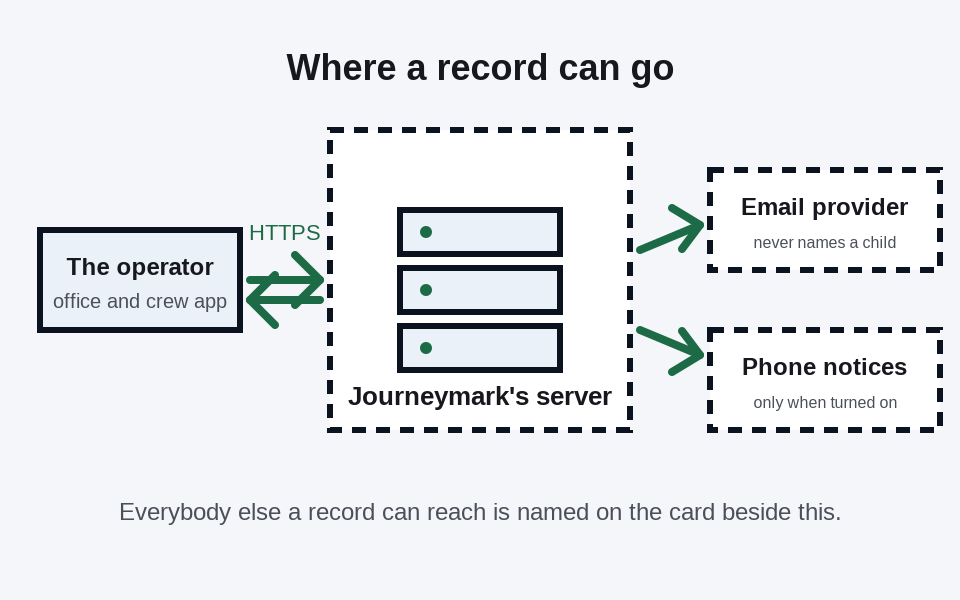
The records live on our server. Very little leaves it, and only for the job in hand: emails that never name a child, notices to a phone if the operator switches them on, stored files and backups, calls in the app (encrypted), the pictures of the papers people upload, which are sent to an AI document reader to be read, home postcodes, which go to a mapping service when the office asks for journey times, and payments, which are made on the payment provider's own page. Some of the companies that help us may be outside the UK, under safeguards that UK data protection law approves.
Apart from this, nothing with a name on it leaves the server. We will tell the operator before we add anything to it.
What we promise
Codes by text
A mobile number is checked with a one-time code sent by text.
Codes by text are sent by a specialist text-message provider that works for us. When you sign in or sign up with a code, or we check a mobile number with one, it sends the one-time code by text to that mobile.
- What the provider gets
- We send it the mobile number and nothing else - no name and no words of ours.
- Who makes and checks the code
- The provider makes the code and checks it, and Journeymark never stores it.
- On what terms
- The provider handles the number only to send and check the code, under data protection terms that bind it to do so, and with the safeguards UK law requires wherever it does that work.
- What we keep, for a year
- A record of each code asked for: the time, what it was for, which login, family link or sign-up it was for, whether it was sent, how many times a code was typed, and the mobile number scrambled with a secret key, so the record does not show the number, for a year and then deletes it. A log line keeps what it was for, whose it was and whether it was sent, with only the last three digits of the number, for a year and then deletes it.
- What we never text
- We text a code and nothing else - never reminders, news or adverts.
What we promise
How it is kept safe
Each operator's records are theirs alone; each login sees what its job needs; what happened on a run is written once and chained, so an edit shows; a login that already has an authenticator app is asked for its code; wrong codes are limited and written down; everything travels over HTTPS. The security page says each of these in full, and it is part of this agreement.
What we promise
Backups that are tested
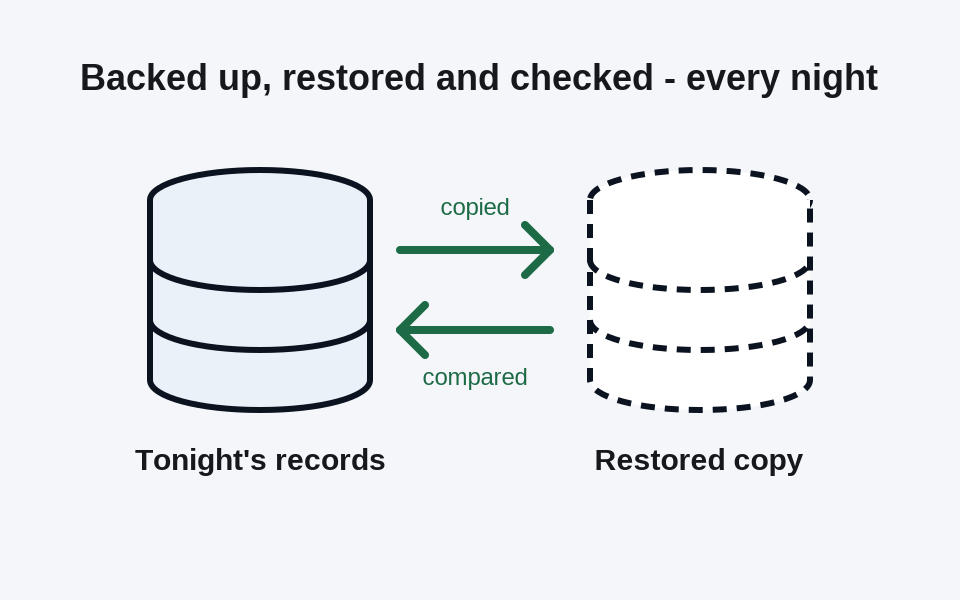
Every night the database is backed up, restored into a separate copy and checked before the backup is kept, and a copy of that proved backup is taken off the server and held by Journey Mark Ltd. Backups are kept only as long as they are needed to recover from a failure, and older ones are deleted. They are held to the same rules as the records they copy. Each backup is encrypted before it leaves the server, with a key held only on the server and by Journey Mark Ltd offline, and the store that keeps the off-site copies encrypts them again.
What we promise
If something goes wrong
If we become aware that records have been lost, altered or seen by somebody who should not have seen them, we tell the operator without undue delay and within 48 hours of becoming aware, with what we know so far: what happened, which records, and what we are doing about it. We help the operator tell the council and, where the law requires it, the Information Commissioner and the families.
What we promise
How long records are kept
The record of the transport is not deleted while an operator's account is open: a child who stops travelling, a driver who leaves or a contract that ends is closed with a date and the record stays, so a question about a run years later still has an answer. When an operator closes its account, the records are kept closed - refused to everybody and handed over only to the operator.
What we promise
At the end of the contract
Data protection law lets the operator choose between having its records returned and having them deleted when the contract ends. Returning them is available now: we give the operator everything that was theirs - a spreadsheet for every kind of record and the documents stored for them, in one download - through a link for their admin that works for a week, and we write down when we made it and what was in it. Deleting them is available too: the operator asks, it happens seven days later so a mistake can be stopped, and we send a certificate of what was deleted and of what the law makes us keep. An operator that asks for neither has its closed copy kept, closed, as above. A council leaving an operator asks the operator, as the controller, for its own records and for what should happen to them.
What we promise
Checking that we do what we say
The operator, or a council on the operator's behalf, can ask us in writing how we look after the records and we will answer with what we actually do, including the results of our own checks. Where that is not enough, an audit can be arranged on reasonable notice, at a time that does not stop a school run. Every look at an operator's account by a council or a parent is already written down on the operator's own screens.
What we promise
Our staff
The people at Journeymark who can reach an operator's records are bound to keep them confidential, and see them only to help the operator. When an operator's own staff leave, the operator stands their login down; when ours do, we stand theirs down the same day.
Article 28 of the UK GDPR
The terms, one by one
What Article 28 of the UK GDPR says an agreement between a controller and a processor must contain.
What is processed, for how long, and why
The subject matter is the transport records the operator keeps in Journeymark. They are processed for as long as the operator's account is open and afterwards as "How long records are kept" says. The nature and purpose: keeping, organising, showing and sending those records so that the operator can plan and run its transport, keep its crew and vehicles within the rules, and show its councils and TfL what ran. The people and the kinds of information are those under "What is processed, and why": children and vulnerable adults, including health information and safeguarding notes; the adults who can be contacted for them; drivers and passenger attendants, including DBS details, which are criminal offence data; council officers given a login; and the operator's own staff.
Only on the operator's instructions
We process the records only on the operator's documented instructions - this agreement, the choices the operator makes in Journeymark's settings, and what the operator's own staff do in it - including about sending them outside the UK. If the law requires us to do anything else, we tell the operator first, unless the law forbids that. If we think an instruction breaks data protection law, we say so.
Confidentiality
Everybody at Journey Mark Ltd who can reach the records is bound to keep them confidential, as "Our staff" says.
Security
We take the measures Article 32 of the UK GDPR requires. "How it is kept safe" and our security page say what they are.
The companies we use
The operator gives us general permission to use other companies to help run the service, such as for hosting, email and payments. We keep a list of them and give it to the operator when asked. We will tell the operator before we add or replace one, so that the operator can object; if we cannot meet the objection, the operator may end this agreement. We make sure each company is bound by written data protection terms to the same standard as this agreement, and we remain responsible to the operator for what each of them does.
Helping with people's rights
When somebody in the records asks to see, correct, delete, restrict or move their information, the operator answers as the controller and we help. Much of it the operator can do itself in Journeymark - find a person's records, correct them, close them, and take everything out in one download - and we help with what it cannot. A request that reaches us is passed to the operator.
Helping with security, breaches and assessments
We help the operator meet its own duties: keeping the records secure; telling the Information Commissioner and the people affected about a breach, as "If something goes wrong" says; carrying out a data protection impact assessment; and consulting the Commissioner where that is needed.
At the end of the contract
The operator chooses whether its records are returned or deleted, as "At the end of the contract" says, and any copy we must keep by law is kept only for that reason.
Showing that we comply
We give the operator what it needs to show that these terms are kept, and allow audits, as "Checking that we do what we say" says.
Which law
This agreement is made under the UK GDPR and the Data Protection Act 2018, and is governed by the law of England and Wales.
Asking for a signed copy
The signed agreement is between Journey Mark Ltd and the operator. If your council would like a copy of what an operator has signed, or wants this wording checked against your own schedule, email hello@journeymark.co.uk and we will send it, or ask the operator to.
Read with
Our privacy notice says what Journey Mark Ltd holds as a controller and what the operator holds. Our security page says how the records are kept safe, in full. Our terms are what the operator signs up to. Our data protection impact assessment sets out the risks to the people in the records and what reduces them.