
Every council tender follows the same broad path, even though each council writes its own documents. This article walks through the stages, how bids are scored, and what happens after you submit. Always read the buyer's documents: where they differ from this article, they win.

Read the whole pack first
The tender documents say what the council wants, how it will mark you, the closing date and time, the deadline for questions, and any minimum scores. The Procurement Act 2023 says a council must describe how tenders are assessed against its award criteria and say whether failing a criterion disqualifies a bid. So the scoring guidance in the pack tells you what a top mark looks like. Write down every date before you do anything else.
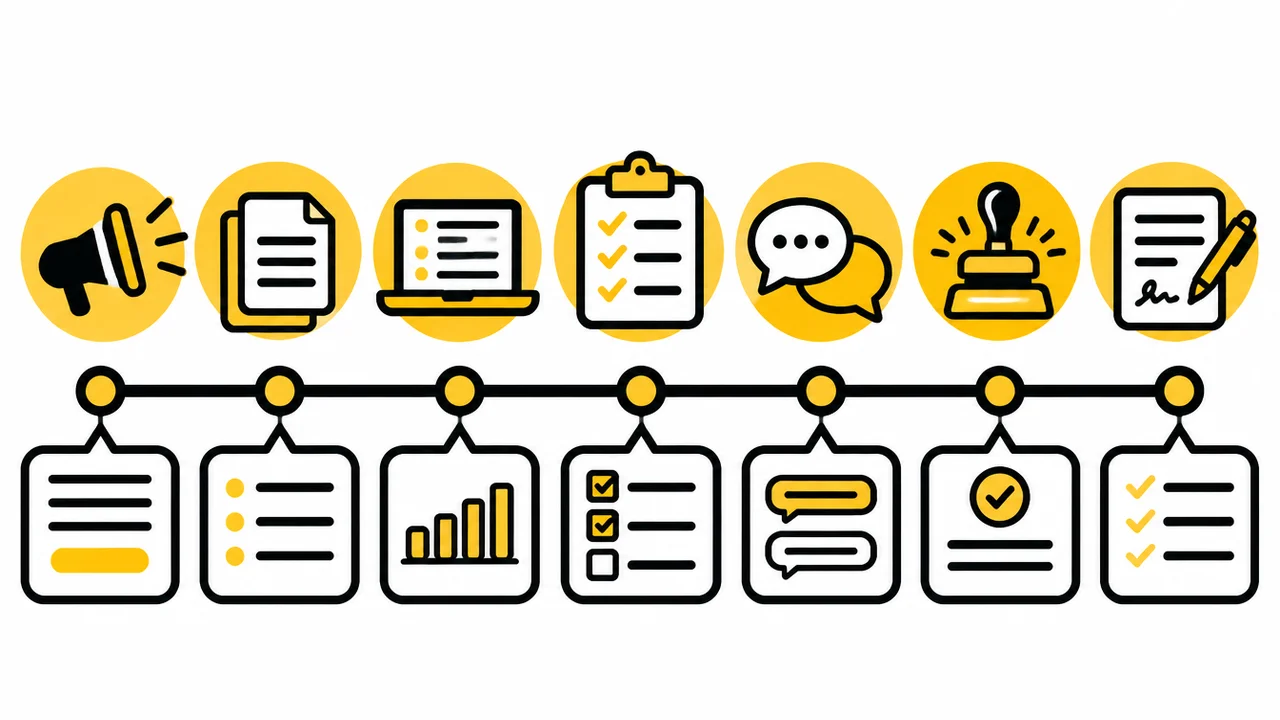
The stages
- Selection questions. These check you are allowed and able to do the work: company details, finances, insurance, licences, policies, references. Under the Act much of this comes from your Find a Tender supplier record, which you share with a share code (see Getting on council portals and frameworks).
- Quality questions. These are written answers, usually called method statements, on things like safeguarding, recruitment, training, vehicles, how the service runs day to day, what happens when something goes wrong, and complaints.
- Price. A rate per route, per mile, per hour or per journey, set out in a pricing schedule you fill in exactly as asked. See Money: pricing a route, VAT and getting paid.
- Social value and sustainability. Some councils score this as its own section. Others fold it into quality.
How quality and price weightings work
A council chooses the "most advantageous tender", which the Act defines as the one that satisfies its requirements and best satisfies its award criteria. The weightings differ by council and by contract, so these are only examples from published documents:
- Hammersmith and Fulham's travel care taxi framework report says Lot 1 (regular and scheduled work) was awarded 60 per cent quality and 40 per cent price, and Lot 2 (ad-hoc work) 40 per cent quality and 60 per cent price.
- Hackney's tender notice for a different service, a community reablement pilot, used 60 per cent quality and 40 per cent price, with a minimum quality threshold of 50 per cent. It said a bidder who scored zero on any quality answer would be excluded.
- Hackney's business case for its passenger transport framework (July 2026) proposes 100 per cent quality to join the framework, with price assessed when individual contracts are called off: "the lowest cost supplier" wins the contract. Its proposed quality criteria are service delivery 25 per cent, safeguarding 20 per cent, health and safety 20 per cent, contract management 15 per cent and sustainability and social value 20 per cent.
So a high price can lose you a bid, but a poor quality score can stop your price being looked at. Some tenders set a minimum quality score. Read it.
How to answer a method statement
- Answer the question asked, in the order it is asked, using the council's own headings and words. Break the question into its parts and tick each one off. A part you miss can cost marks.
- Be specific. Say who does what, how quickly, how you record it and how you check it happened.
- Give evidence: records, numbers, a short example with no child or family named. "We always" scores lower than a description of the record you keep.
- Write about this contract. Name the borough, the kinds of passenger, and the problems the specification describes.
- Keep to the word limit. Do not paste a policy in place of an answer.
- Have someone who did not write it read each answer against the question.

Clarification questions
If something in the pack is unclear, ask. Councils often take questions only through the portal and only until a stated date, and may share the answers with every bidder. Bromley's guide for its portal says queries go through the portal's messaging, its answers may be shared with other tenderers, and no verbal clarifications are given. Do not rely on a phone call.
Deadlines and late bids
The closing date and time are in the notice: Hackney's reablement notice, for instance, gave an enquiry deadline and a tender deadline at 12:00 noon on a named day. Portals close at the time stated. Bromley's guide, for example, says tenders received after the closing time will not be considered unless the council has extended it. Submit at least a day early, check every upload opens, and keep a copy of everything you send.

After the closing date
The council marks your answers and price. It may ask follow-up questions or hold a presentation. Before it publishes the contract award notice, the council must give each bidder whose tender was assessed an assessment summary: information about how it assessed that tender and, if different, the winning one. Read it whether you win or lose.
After the award: eight days to object
The council publishes a contract award notice. For most contracts an eight-working-day standstill starts that day, and the council cannot sign the contract until it ends. If you think the decision was wrong, act inside those eight days and take advice.
The Act says there is no compulsory standstill for:
- a contract awarded under a framework;
- a contract awarded by reference to a dynamic market;
- a "light touch" contract (mainly certain social, health, education and other public services).
A council can still choose to give one.

If you do not win
Use the feedback and try again. A place on an always-open list, and a record of good work on it, is a sensible first step before bigger tenders. See The catches: do's and don'ts.
Sources
- Procurement Act 2023, section 19 (award following competitive tendering) - https://www.legislation.gov.uk/ukpga/2023/54/section/19/enacted (opens in a new tab)
- Procurement Act 2023, section 23 (award criteria) - https://www.legislation.gov.uk/ukpga/2023/54/section/23/enacted (opens in a new tab)
- Procurement Act 2023, section 50 (contract award notices and assessment summaries) - https://www.legislation.gov.uk/ukpga/2023/54/section/50/enacted (opens in a new tab)
- Procurement Act 2023, section 51 (standstill periods) - https://www.legislation.gov.uk/ukpga/2023/54/section/51/enacted (opens in a new tab)
- GOV.UK, Procurement Act 2023 guidance: contract award notices and standstill - https://assets.publishing.service.gov.uk/media/66aa2d7efc8e12ac3edb0875/Guidance_-_Contract_Award_Notices_and_Standstill_.pdf (opens in a new tab)
- Hammersmith and Fulham, Travel Care Taxi Framework Award report - https://democracy.lbhf.gov.uk/documents/s131798/Travel%20Care%20Taxi%20Framework%20Award.pdf (opens in a new tab)
- Hackney, Community Reablement at Home Pilot notice on Find a Tender - https://www.find-tender.service.gov.uk/Notice/018563-2026 (opens in a new tab)
- Hackney, Passenger Transport Framework business case (Hackney Procurement Board, 14 July 2026) - https://hackney.moderngov.co.uk/documents/s99051/HPB%20Business%20Case%20-%20Passenger%20Transport%20Framework.pdf (opens in a new tab)
- Bromley, instructions for tenderers on how to use ProContract - https://www.bromley.gov.uk/downloads/file/835/instructions-for-tenderers-on-how-to-use-procontract (opens in a new tab)
- Procurement Act 2023, section 9 (light touch contracts) - https://www.legislation.gov.uk/ukpga/2023/54/section/9 (opens in a new tab)
- GOV.UK, Procurement Act 2023 guidance: light touch contracts - https://www.gov.uk/government/publications/procurement-act-2023-guidance-documents-plan-phase/guidance-light-touch-contracts-html (opens in a new tab)
- Procurement Act 2023 guidance: light touch contracts (Cabinet Office) - https://assets.publishing.service.gov.uk/media/68e79c8d1c8b2a3b506907a4/Guidance_-_Light_Touch_Contracts_FINAL_pdf_links_.docx.pdf (opens in a new tab)
Checked on 28 October 2026
This is general guidance, checked against the official sources on the date shown. It is not legal, tax or insurance advice: check your own position with TfL, HMRC, your insurer or a solicitor.